-
Wow Buzz, I think we should all leave the forum and let you answer all the questions because it seems that no matter what some else says or what their experience you aways seem to have a better answer.Leave a comment:
-
on the straight and narrow-
if you look at the profile of the track crossers, you'll see that some are very flat and square on the bottom (escargo...even more beneficial w/square tires but even round tires work very well)...while other tracks are much more rounded where the tire rides (adair). Either way, I agree that square tires might help a little in theory, but the stability of the guides in an elevated belt track is what makes it very difficult to throw. It also doesn't require a tremendous amount of tension/high tire pressures to "try" to help keep the guides (which depend on high belt tension) from tilting or folding over. Riding around with high air pressures sucks. It's also a good way to pop tires. Even if a track with ground-level belting is very tight, it can still have its guides tilted, folded over, and driven out of. The high tension and minimal (almost non existent) track sag recommended with a pro series install can't be good for your corner hub flanges or corner bearings...tire slipping that is required arguably becomes more difficult as track tension goes up....just something to think about. Remember, we're talking about adair vs. escargo. Not rubber tracks and their "high friction". We're talking about smooth, individual crossers that can slip. The escargo has cleats that can self-adjust and require far less track tension, while the pro has crossers than cannot self adjust but require higher track tension. But at least they're smooth. It doesn't help that the skinny belts on the pro don't offer much resistance to twisting. All it takes is the right situation with the right amount of side load on the tracks, and you can peel them right off. Lighter machines with only 3 axles or very small tires can keep them on a little better (as long as they're tight)...but it can still happen....especially if you accidentally forget to "completely brake" your inside track. I've heard that excuse too. These are just things that happen.....and realistic factors to consider when you actually drive and use your machine heavily loaded or in bad conditions.
It is what it is, I'm sorry. Tire shape is simply not the problem, or a good excuse. Cranking the tension up still doesn't offer reliable solution either.
It would be easy to make a thick durable looking track crosser, connect it with heavy duty belting, (after all escargo does and has successfully for quite some time), and assume it's going to work really well. Shoot it should be bouyant too, right? Well, you're forgetting the most important aspect of the escargo track...the elevated belt. That's why it works so well especially with aggressive traction.
Heavy-duty rubber belts are very well suited to an "elevated belt" design, because the guides are affixed here....the belt is not going to stretch....so your guides simply cannot move or fold...each guide cannot move farther away from its neighbor....in either direction.
With very rounded tires, a lot of weight and cargo, and horrible sidehilling/turning conditions, I still cannot drive out of my escargo track.
Can a pro series style track be made with a much more "square" tire area? I was curious and mentioned this awhile back? There is only so much remaining plastic "hinge" wall thickness left nearest the tire...before there is nothing connecting the guide to the cleat at all?
Square tires might help a little....lotsa air pressure tries to help...having only 6 axles or small tires might help...but none of these are the answer. Especially when you can't get away from "plowing" the belt. Sometimes the track simply does not want to turn...but your tires..and your machine..does.
The answer is in the guide-stablility and non-belt-plowing of an elevated belt track. If you expect it to be reliable in the backcountry anway. Some people don't need..or want that. Some of us do though.Last edited by Buzz; 03-02-2014, 07:13 PM.Leave a comment:
-
@Foxvalley, with flat tracks the addition of steel cleats may well help with traction, but also majorly increases weight and since the traction remains on the ground at all times it would make it very difficult to turn especially loaded and very much so in the spring, summer and fall seasons.
with an elevated belt design you can add some additional traction and yet have the ability to turn as it will be off the ground when not in the deep mud or skeg! aside from that it will increase the swim factor of that type of track.
RockLeave a comment:
-
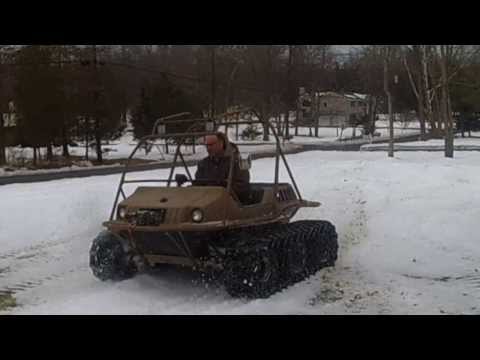
Reference throwing a track: I purchased my Argo Frontier with a set of 25" rawhideIII tires and a set of Adair tracks, I also ran a set of the second Generation Adair tracks with the 24" Argo swimmer tire and the 14.5 inch track.Originally posted by foxvalley View Post
I will be the first to tell you the 24" tire is much better suited to being tracked.
I did notice on a number of occasions that the track mounted with the 25" tires would roll left and right as you were going down the trail or in ruts or mud lanes. The rolling can be observed in a couple of my videos. When I switched to the 24" tires with the more square narrow design the rolling absolutely went away and the ride quality of the 24" tires was far superior to the 25" tires.
As long as you keep the 24" tire aired up properly it would be very difficult to walk out of them although on occasion I did have some issues in very soft mud with roots and tree limbs. The main thing is to keep the tires properly inflated and you should never have an problem losing a track with the more squared off tires.
Having said that if you ever did walk out of a track it's not a big deal to put them back on as long as you have an air pump with you to deflate and inflate the tires.Leave a comment:
-
Hmmm, I was going to try to help with the weight question, but read the question wrong. Can't help with those track particulars but since I went and weighed my Pro Series w/ snow kit for my conquest.....
18.5" Pro Series to fit Conquest rang in at around 146lbs. Hard to get a good weight without hanging them from a scale, did the best I could though.
Can't get a weight on them without winter kit unless I pull the tracks off my other machine or pull a winter kit off one of these others.
Not to muddy the waters, but those with conquests might be interested.
RDLeave a comment:
-
what is the weight of a pro-series track by itself (14.5" all-uhmw) to fit an avenger or mudd-ox w/25" tires, and how much does it weigh to get an overall width of 18.5 or 20.5" with traction cleats ?Leave a comment:
-
Well personally I don't spend my time ridding down quad trails and just pushing through mud puddles, any track can accomplish that task, I require tracks for the super extreme situations, not the more normal quad trails.
An elevated belt seems like it would have a lot less chance of de-railing, my reason for believing this is the flat tracks are too much like an argo plastic track design that have a pretty ridged side rail system, which you can easily walk out of if not very tight and very overinflated tires arnt used, and even then they can come off this observation is from 38 yrs of argo experience.
the elevated belt design is still in use by adair, escargo and channel tracks, I have not heard of any of them ever derailing even under loose or low inflated tire conditions.
That says a lot for the design. IMO
RockLeave a comment:
-
with any luck we'll try with and without winter kits too. I actually have some AT101's headed my way in 24x12-12. They'll go on mudd-ox 12" rims. Though not the typical 8-ply of Argo's centaur turf-tire, they still have a good weight rating in that size, have 12" width I'm looking for, and are under 24" diameter for a bit more room (twin-track). The chevron tread has a bit more utility if I use them on something else too.Leave a comment:
-
foxvalley, you make a great point. During my "playing around" I've actually slotted a few different crosser shapes to sandwich full-thickness steel flatbar so as to help the traction issue. Seems like the u-channel shaped notched cleats that are added to Adair's belting are aggressive. Just wanted to try something different. I figure a cleat that easily skid turns but still provides forward/backward traction should be a good thing. I've had issues with u-shaped cleats packing with snow ice. The pro track uses deeper u-shaped cleats so it may not be an issue at all.Leave a comment:
-
[QUOTE=Buzz;158986]A track comparison for Alaska specific conditions is exactly what I'm after. No outrageous claims, just honest testing.Leave a comment:
-
I also believe it to be extremly difficult to throw a track,as I have been trying to do just that for the last couple of years. I believe that if you are not running enough tire presure in the tires,that the possiblity of this happening increases greatly.
I also believe that there is very little chance of sidewall issues,as I have neither heard of or experienced any wear whatsoever on the sidewalls.
The pro series has a shorter, heavier grosser to accomodate narrow trail use,for example, guys like RD getting thru between trees in the trail,etc.
I am still a big fan of the 18" chain tracks,and had a real hard time being convinced otherwise,but the pro series,with the addition of the winter kits,is much more aggessive not only on ice,but in the deep swamps where submerged logs are a non issue for the steel cleats.
Buzz, I think it's great that you are doing a comparison between the two types of tracks,however, if you want to do a fair comparison, either put on the winter kits on the pro series, or take off the steel grossers on your rig.Leave a comment:
-
I'd be interested as well in seeing under-inflated tires stay in your track (is it 6 or 8 wheel?) during significant maneuvering, sidehilling, and on sticky terrain. Especially in an 8-wheeler. That's a very hard thing to accomplish, especially if your tire guides are not-fixed at the side-wall level and track-tension is lost.Leave a comment:
-
A track comparison for Alaska specific conditions is exactly what I'm after. No outrageous claims, just honest testing. 6-wheeled tracked AATV's mud-bogging and riding in terrain parks is tons of fun I'm sure. But the factors driving track selection for a large-tired heavily loaded 8x8 in Alaska conditions are much different. This may help the Adair pro-series design if it's proven to do the job.Leave a comment:

Leave a comment: